Green Patches - Mediterranean Gardening

Saturday, August 18, 2012

Kalanchoe Marmorata Stem Rot And What To Do About It!

4 comments
Lately I had been keeping an eye on an ominous brown spot that appeared in the beginning of July on my Kalanchoe Marmorata.  It looked vaguely familiar, but since we are in the middle of Summer, I didn't really think much of it at first.  The main stem had a lovely green color, and looked healthy enough.

kalanchoe marmorata stem rot
The First Sign Of Trouble
Yesterday as I picked up the pot from its shelf to water the plant, my fears came true.  As I picked up the plant the main stem broke off completely, the end bit was completely rotten.  My Kalanchoe Marmorata has stem rot!

kalanchoe marmorata stem rot
Broken Stem With Rotting Base
kalanchoe marmorata stem rot
Kalanchoe Stem That Broke Off

This must be the fourth plant that I lost to stem rot in the last three years, and this time I was determined I was going to try and save it.  The stem had not yet gone yellow or brown, meaning that the fungus had not yet started to creep up.  I decided to cut off the rotting part, and check out the inside of the stem.  When cutting a rotting stem, I try to cut right under a bud or leaf, as it encourages new growth.

kalanchoe marmorata stem rot
Cutting Off The Rotting Part
kalanchoe marmorata stem
A Cross Section of The Stem

I cut off some leaves at the base to increase the length of the stem, and placed in a new pot with some potting mix.  I put it in a small pot, because I didn't have a larger one, and because I was not going to water it much anyway.  Just a bit of water to encourage the stem to take roots.

kalanchoe marmorata propagation
Newly Potted Kalanchoe

Since the original plant had two stems I decided to do the same with the other stem.  I cut it off at the base, removed the rotting stem and root ball, and repotted the stem in its old pot.  This may not be a good idea, as the potting mix would be full of bacteria, and disease from the fungus, but I decided to risk it.  

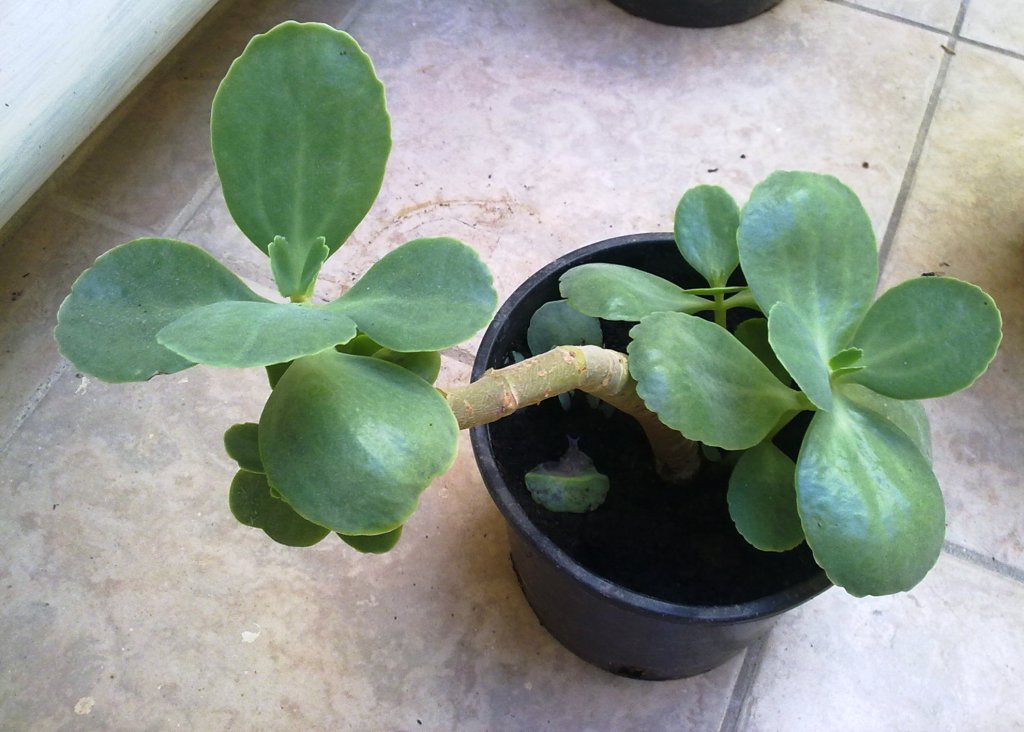
I removed all the soil from the rotting stem and roots to see what's going on there.  I wanted to see what stem rot was really about. Here's what I found:

kalanchoe marmorata rot
Rotten Stem and Root Ball
kalanchoe marmorata rot
Excuse The Dirty Fingernails !!

The top part appears brown and rotting.  It was soft to the touch and kind of squishy. The rest of the stem and roots however appear to be fine.  The other stem was not rotten, which leads me to believe that I may as well have left the other stem of the plant intact.  The roots also appear to be just fine.

Another solution could have been to remove the plant from the soil, gently removing all the soil from the roots, and cutting off just the roots, or stem that appear rotten.  If I had caught it earlier, I could have left the plant intact, and just cut off some rotting roots.  In any case I think I made the right decision to try to save the plant.  I did sacrifice the little bud that you can see in the picture above, but I now have three pots of Kalanchoes, and that's more than enough.

Here is what I think happened.  The Kalanchoe is a cutting from another plant I have in my container garden.  I placed it in a big pot, and soaked it with water. The cutting was quite large, but the roots were still short.  Placing the plant in a big pot was not really an issue, the problem was my soaking the entire pot with water.  The roots could never have absorbed that much water.  Since we are in summer, the topsoil was getting dry as the sun evaporated the moisture, but that didn't mean that the Kalanchoe needed water.  I hope to do better with these two now.
Read More...

Thursday, August 9, 2012

Orange Blooms For My Kalanchoe

4 comments
My Kalanchoe is finally blooming.  I was so curious to see what flowers will emerge, and Donna they are orange flowers too!  Here are some pictures I took this morning.  


kalanchoe flowers

The light is playing tricks on me here, the flowers look pink but they are in fact orange...

kalanchoe flowers

I had to support the plant with a bamboo stick because it grew too long and it sort of coiled in on itself.  I was afraid the main stem was going to give way. but as it turns out, the main stem is just as thick as the rest so it just bent, and let gravity take over.  Now it look much prettier.

kalanchoe flowers

kalanchoe flowers

kalanchoe flowers

It took a lot of juggling to take these last three pictures, so I didn't care much about the light, as long as the plant didn't move I was snapping away.

For some reason when flowers bloom I always feel excited, its like receiving presents on your birthday or Christmas, you just have to smile :)

Here they are in full bloom now:

kalanchoe flowers
Kalanchoe Flowers In Full Bloom

Read More...

Saturday, July 21, 2012

Who Gardens In A Summer Heat Wave?

5 comments
What a month July has been so far.  We've both been very busy lately with all sorts of things life throws at you from time to time.  Some have been good, some not so good, but to add to the madness of these past three weeks, nature decided to help us out by scorching us with a heat wave that seemed never ending.  Needless to say, tempers were on edge, and it was tough to keep up the momentum when all you want to do is lie down on the sofa with the air conditioner on at full blast.  

My yard was not a happy yard this month.  Temperatures rose to about 36 degrees Celsius (96 F) from 28 degrees almost overnight, and the heat stress index was about 45 degrees (113 F).  My plants joined us in our slumber, and everything stopped growing.  Now that the temperatures are back to normal I decided to go have a look, and maybe do some trimming here and there.  

The plant that got the most damage surprisingly enough was my Jade plant.  I still keep this plant indoors on a windowsill, and now I realise it may not have been such a good idea.  The leaves have started bleaching and going yellowish in colour, despite my watering it regularly.  

jade plant, yellow leaves
Jade Plant Leaves Going Yellow

I have also noticed that some leaves have brown spots on them, or brown edges, like someone concentrated a beam of light on them and burnt them.  It's possible that this is due to the window acting like a lens (does that make sense?).  In any case I have now removed it from the window sill and placed it on a makeshift dining table near the window, that way it will still get the light, but not as direct as it used to.

jade plant leaf
Leaves with brown spots

jade plant, yellow leaves
More brown spots and some 'burnt' edges

Outside in the yard, things are pretty much the same.  The two Kalanchoes are doing very well, and they seemed unaffected by the heat.  I did notice some burnt leaves on the 'Baby Kalanchoe' but nothing too worrying I hope.  It still has lots of healthy new leaves.

kalanchoe marmorata
Mummy Kalanchoe

kalanchoe marmorata
Baby Kalanchoe growing strong

My Plumbago has stopped flowering altogether these past weeks.  Today I trimmed it a bit and removed all the dead flowers.  This week I have a couple of flowers in bloom so it looks like it's waking up from its slumber and back to producing those lovely purple flowers.

Speaking of flowers, there are none on my Kalanchoe yet.  The buds have increased though, but I'm still waiting.

kalanchoe marmorata flowers
Still waiting for those flowers

The biggest tragedy of all this month must be my basil.  I normally sow a pot of basil each year from seed and keep it on our roof so it can get all the sunshine it needs.  It appears however that our sun is a bit too much for the basil, and to add to its misfortune I have not watered it nearly as much as I should have.

basil dried
Basil Tragedy

I have made it my mission to revive this plant.  I have been told to cut it right to the ground and it will revive itself, but I couldn't bring myself to do that.  I'm still very careful with the shears, more than I need to be, but I'm still uncomfortable with just cutting off to my heart's content.  I brought the pot in to the yard, where it will stay for the rest of its days.  I cut off all the dead stems and the flower heads.  Any stems which had green leaves on them I left, and I gave it a bit of water.  

basil dried
Basil in recovery

So there's my Summer update so far.  Not much action, but that's normal for us here.  Hope you are having a more relaxing and cooler Summer, and hope that August does not burn us to a crisp.  Fingers crossed.


Read More...

Thursday, July 5, 2012

Kalanchoe Summer Bloomer

4 comments
I can't believe it's been almost two weeks since my last post.  We're having such a busy month this month we are hardly spending any time at home let alone in my yard looking at my plants.  It's just one of those crazy times we all go through I guess from time to time.  This morning as I rushed out to water my rather neglected plants I had a lovely surprise.  My little Kalanchoe ( I don't know the actual name) is almost in bloom :)

kalanchoe
The Kalanchoe has grown quite long in a couple of months

kalanchoe
Three lovely buds
I took these pictures with my mobile phone at six o'clock this morning, so they are not exactly first class.  This plant has been relatively quiet all year growing little by little.  Now, however, it suddenly had a growth spurge, and has grown very long in just a couple of months.  Like the rest of the Kalanchoes I don't water this one very often, and it doesn't seem to require that much either.  It takes a long time for the soil to dry so I pretty much leave it alone.  The soil is very well drained, a bit too much I think, because when I water it, the water just goes straight out of the pot to the ground.  It doesn't seem to mind that though.  

I am very excited to see what the flowers will look like.  This is the first Kalanchoe to make flowers in Summer, the other two flowered in Winter.  It's great that despite coming from the same family (of a few thousand different species) they have such great differences.  

Read More...

Saturday, June 23, 2012

To Water Or Not To Water In The Sun

6 comments
portulaca flowers
My Portulaca Flowers in a Summer Day Before Closing In The Evening


When I first started out gardening, the first advice I got was to never water plants during the day.  It had to be either first thing in the morning, or in the evening.  Unfortunately, these times also happen to be when I am most forgetful so I hate to admit it, but I have broken this rule often for the sake of my plants.  In the summer heat, this piece of advice comes more as an impostion for me, it is the time when the plants needs most water, but it is also the time when I am hardly around to do that.

So why is it bad for plants to water them in direct sunlight?  It was never quite explained to me. This was like a defacto standard around our house when I was young watering my father's plants, no questions asked.  This afternoon as I was trimming down my Plumbago I was tempted to water it, and I remembered this rule.  I decided to do a little search on the net to better understand this.  

It was always my silent understanding that it was bad to water the plants in the sun because the water simply evaporates too quickly.  It did not make much sense, therefore, because the plants would not be getting their full share of water, and more water would be wasted in the process.

Apparently, however, there is another debate going on on the Internet. Two conflicting articles written in 2010, one from the Daily Mail and the other from the Daily Telegraph helped in this confusion.  The Daily Mail claims that the reason it is bad for the plants, researchers found, is that the tiny droplets of water on the leaves of the plants act like a magnifying glass, intesifying the heat, and could also lead to leaf burn.  The Daily Telegraph on the other hand claims that this myth has been 'debunked', and that researchers have proved that this is simply not true.  So I'm back to square one.

Another reason I found online is that the plants open up their pores when they are watered, because they think that it is raining.  Since it is actually scorching hot, this may damage, and burn the plants.  Someone else argued that watering the plants in the morning, or evening allows the water to sit longer in the soil, or plants, which may lead to root rot, or fungus to develop.

As I was thinking about watering my Plumbago this afternoon, a very simple fact made me decide not to.  As I opened the tap to fill up my watering can, I realised that that the water was boiling hot.  I couldn't even touch the first few litres of water until the pipes cleared.  My plants would surely suffer if I gave them that water. If I had to throw away a few litres of water every time to let the cool water run down the tap I would be wasting more water, and money.  

After all this, I came to the conclusion that it all depends on the intensity of the sun.  If it's too hot, don't bother.  Save yourself some sweat, and do it in the evening.  If the plants are just wilted with the heat, but they are actually in a shady spot then I guess it won't do much harm.  In my case, I guess the water is just too hot for them, best to do it when it's cooler.  

What's your opinion?  Feel free to share, as always :)


Read More...